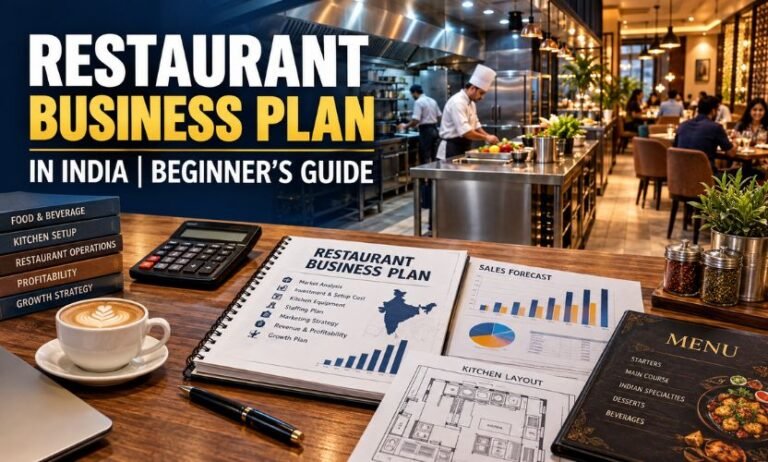
Starting a food business can be exciting, but enthusiasm alone does not build a sustainable restaurant. A clear restaurant business plan turns an idea into a practical roadmap covering investment, customers, operations, compliance, and growth. In this guide, Restaurant Business Plan in India: Complete Guide for Beginners, we explain how to plan your venture step by step.
Understand the Purpose of a Restaurant Business Plan
A restaurant business plan explains what you want to build, whom you want to serve, how the business will operate, and how it can become financially sustainable. It is useful for founders, investors, lenders, consultants, and project teams.
What Should Be Included?
A practical plan should cover:
- Restaurant concept and business model
- Target audience and competitive positioning
- Market research and competitor analysis
- Restaurant location and location selection
- Startup investment and operating expenses
- Kitchen design, equipment, and workflow
- Menu planning and pricing strategy
- Marketing, staffing, and restaurant operations
- Legal requirements and financial projections
Good restaurant business planning also identifies risks before money is committed. It helps you compare assumptions against actual market conditions and revise the idea before construction or procurement begins.
Build the Right Restaurant Concept and Business Model
Your restaurant concept should define the cuisine, service style, atmosphere, price level, and customer experience. Decide whether you will operate as dine-in, takeaway, delivery, or a hybrid business.
Define Your Customer and USP
Start by identifying your target audience. Students, office workers, families, tourists, and premium diners have different expectations around pricing, ambience, convenience, and menu choices.
Your restaurant business model should then explain how the venture will earn revenue. A strong USP could be speciality cuisine, speed, affordability, premium hospitality, regional authenticity, or a distinctive dining experience.
For a restaurant startup business plan, document:
- Cuisine and menu concept
- Seating capacity
- Average expected bill value
- Service channels
- Delivery strategy
- Competitive advantage
- Customer retention approach
This foundation makes later decisions about the restaurant budget, staffing, equipment, and marketing much easier.
Conduct Market Research Before Choosing a Site
Market research should validate demand rather than confirm what you already believe. Study customer preferences, local spending patterns, cuisine demand, market trends, and competitor strengths.
Evaluate the Location Carefully
When considering how to choose a restaurant location, examine foot traffic, accessibility, parking, visibility, nearby businesses, competition, rent, utilities, and the proposed rental agreement.
A restaurant feasibility study should compare at least two or three locations using the same criteria. Visit potential sites at different times and observe actual activity instead of relying only on online listings.
Useful research questions include:
- Who lives or works nearby?
- What restaurants already serve them?
- What price points are common?
- Is demand stronger during lunch, dinner, or weekends?
- Can deliveries reach the area efficiently?
This process makes your restaurant business planning more evidence-based and reduces the risk of choosing a visually attractive but commercially weak location.
Calculate Restaurant Startup Costs Realistically
There is no universal restaurant startup cost in India. Investment varies by format, city, size, cuisine, property condition, and equipment requirements. Recent Indian estimates show substantial differences between cloud kitchens, QSRs, casual dining, and premium restaurants.
Create a Detailed Startup Budget
Your restaurant investment plan should separate one-time setup expenses from ongoing costs.
Consider:
- Rental deposit and advance rent
- Restaurant interior design and furniture
- Restaurant kitchen setup
- Commercial kitchen equipment
- POS system and technology
- Licenses and registrations
- Initial inventory
- Launch marketing
- Working capital
For kitchen planning, consult experienced Commercial Kitchen Equipment Manufacturers in Delhi when your project requires custom fabrication, workflow planning, and installation. A reliable Commercial Kitchen Equipment Supplier in Delhi can also help coordinate equipment procurement according to the menu and available space.
Do not budget only for opening day. Your restaurant startup plan should maintain sufficient working capital for early operating expenses while revenue builds.
Build a Practical Restaurant Financial Plan
The financial section should translate your concept into numbers. Start with a sales forecast based on seats, table turns, average order value, operating days, and expected delivery revenue.
Your restaurant financial plan should include:
- Revenue projection and sales forecast
- Food cost and labor cost
- Rent and utilities
- Other operating expenses
- Working capital
- Cash flow projection
- Income statement
- Balance sheet
- Financial projections
- Break-even point
- Expected profit margin
When learning how to calculate restaurant break-even point, compare fixed costs with contribution generated by each sale. Also test conservative, expected, and optimistic scenarios.
A strong restaurant investment in India should be assessed against realistic revenue assumptions, not best-case sales. This makes the plan more useful for investors and lenders.
Plan Kitchen Infrastructure and Equipment
The kitchen should be designed around the menu, production volume, staff movement, storage requirements, hygiene, and service speed. Equipment should support the workflow rather than simply fill available space.
Design the Commercial Kitchen Workflow
Plan separate areas for receiving, storage, preparation, cooking, plating, washing, waste handling, and dispatch where practical.
Work with a Restaurant Kitchen Equipment Manufacturer in Delhi when custom stainless-steel fabrication, exhaust systems, counters, refrigeration, or cooking equipment are required. An experienced Commercial Kitchen Equipment Manufacturer in Delhi team can help align equipment specifications with your operational needs.
A second consultation with a Commercial Kitchen Equipment Supplier in Delhi can help compare equipment options, capacities, warranties, installation, and after-sales support. Another Restaurant Kitchen Equipment Manufacturer in Delhi may be useful when comparing fabrication quality and project execution.
The objective is an efficient commercial kitchen with safe movement, appropriate storage, food safety controls, and maintainable equipment.
Complete Legal and Compliance Requirements
Compliance should be planned before operations begin. Requirements vary by business structure, state, municipality, premises, and services offered, so verify applicable rules with the relevant authorities or a qualified professional.
The restaurant business requirements may include:
- Business registration
- FSSAI registration or licensing
- GST registration
- Trade license
- Health-related local permissions
- Fire safety certificate or NOC, where applicable
- Shop and Establishment registration
- Local municipal permissions
- Additional permits based on the concept
FSSAI states that every Food Business Operator must be licensed or registered under the applicable food-safety framework.
Therefore, an FSSAI license for restaurant operations should be treated as a core compliance requirement. The exact restaurant registration in India, restaurant license in India, and GST registration for restaurant obligations should be verified for your location and business structure. Current CBIC material also specifies applicable GST treatment for restaurant services, including the stated 5% rate without input tax credit for restaurant service outside specified premises.
Create the Operations, Menu, and Pricing Strategy
Your operations plan should explain how the restaurant will function every day. Define supplier standards, procurement routines, inventory levels, preparation procedures, service standards, cleaning schedules, and quality checks.
Make the Menu Commercially Viable
Use menu planning and menu engineering to identify profitable and popular dishes. Calculate recipe-level food cost, standardize portions, and establish a pricing strategy that considers ingredients, labor, overheads, taxes, wastage, and desired margins.
Your restaurant operations plan should also cover:
- Food suppliers and raw material sourcing
- Inventory management
- Food storage and hygiene
- Restaurant staff hiring
- Chef, kitchen staff, and service staff responsibilities
- Training and quality control
- Maintenance and food waste management
For practical implementation, Restrobar Kitchens can help food businesses think through restaurant kitchen setup, equipment selection, workflow, and operational requirements as part of a broader project approach.
Develop Marketing and Growth Strategies
A restaurant needs customers before it needs scale. Your restaurant marketing plan should combine branding with measurable customer acquisition and retention activities.
Use:
- Restaurant branding and local marketing
- Digital marketing
- Social media marketing
- Online food delivery
- Google Business Profile visibility
- Customer reviews and reputation management
- Loyalty and retention campaigns
- Opening promotions and community outreach
Track which channels generate visits, orders, repeat purchases, and profitable customers. Marketing should therefore connect directly with your pricing, customer experience, and financial targets.
A useful restaurant business strategy also plans for growth. Expansion may involve a second outlet, delivery-focused operations, catering, franchising, or a new customer segment, but only after the first unit demonstrates operational and financial discipline.
Turn Your Plan Into an Actionable Roadmap
If you’re wondering how to put together a restaurant business plan in India, start with real facts, not hunches, because that’s what matters. The whole restaurant planning process kind of needs to flow from concept validation into location, then investment, compliance, kitchen design, day-to-day operations, marketing, and finally financial testing. It sounds simple, but you still have to keep moving step by step.
Use a Simple Implementation Checklist
A practical restaurant business plan format can follow this sequence:
- Define the concept, USP, and target customer.
- Complete market research and competitor analysis.
- Shortlist and evaluate the restaurant location.
- Prepare startup costs and working-capital requirements.
- Develop the kitchen layout and equipment schedule.
- Complete registrations, licenses, and compliance checks.
- Finalize menu, recipes, suppliers, pricing, and staffing.
- Prepare the marketing and launch strategy.
- Build revenue, cash-flow, and break-even projections.
- Review assumptions before committing major capital.
Keep the document updated as quotations, rents, menu costs, staffing plans, and sales assumptions change. A restaurant business planning document should be a working management tool, not a file created only for a loan application.
For example, a tiny café might end up needing a different restaurant business plan template than, say, a cloud kitchen, QSR, or even a full-service restaurant. And the same thing sort of goes with a restaurant business plan example too; you can use the structure as a guide, but then swap the assumptions for verified, project-specific numbers.
Conclusion
A successful restaurant starts way before the first person even walks in. Thoughtful planning kind of stitches together the whole idea, the target crowd, the exact spot, the money, the kitchen infrastructure, compliance, the menu, staffing, promotions, and profitability into one smoother roadmap, even if it feels like a lot at once.
If you’re drafting a restaurant business plan for opening, keep an eye on realistic numbers, tight day-to-day operations, food safety, and real customer demand. A disciplined approach helps you dodge pricey mistakes and keeps you making smarter calls while the business grows, not just in the beginning.
Restrobar Kitchens backs food businesses with practical commercial kitchen solutions, equipment planning, fabrication, and setup guidance. If you want to talk about your next project, reach out via the website or swing by our Google Business Profile to see more about what services and products we can provide.


