
Running a successful restaurant today requires more than good food and friendly service. Restaurants must also understand how menus influence customer choices and profitability. That is where menu engineering plays a crucial role.
Many hospitality professionals, including a Food and Beverage Consultant in Delhi, recommend menu engineering as a core strategy for improving restaurant revenue and customer satisfaction. When implemented correctly, it helps restaurants analyze their menu items, optimize pricing, and guide guests toward the dishes that benefit both the business and the customer.
In this guide, we will clearly explain what menu engineering in food and beverage, how it works, why restaurants use it, and how it connects with concepts like food and beverage service in hotel management, flatware, and glassware in the hospitality industry.
Understanding the Food and Beverage Industry
Before discussing menu engineering, it is helpful to understand the broader food and beverage (F&B) industry.
The food and beverage service in hotel management refers to the department responsible for preparing, presenting, and serving food and drinks to guests. This department operates restaurants, bars, room service, and catering within hotels and hospitality businesses.
Its responsibilities typically include:
- Food preparation and menu planning
- Beverage service and bar management
- Table service and guest experience
- Cost control and food safety
- Menu pricing and profitability
Restaurants rely on this department to manage everything from menu design to service equipment such as flatware and glassware.
For example:
- What is flatware in food and beverage?
Flatware refers to eating utensils used during dining service such as forks, knives, and spoons. - What is glassware in food and beverage?
Glassware includes all types of drinking glasses used in restaurants, such as wine glasses, cocktail glasses, and water glasses.
These items may look simple, but they contribute to the overall dining experience and presentation.
What Is Menu Engineering in Food and Beverage?
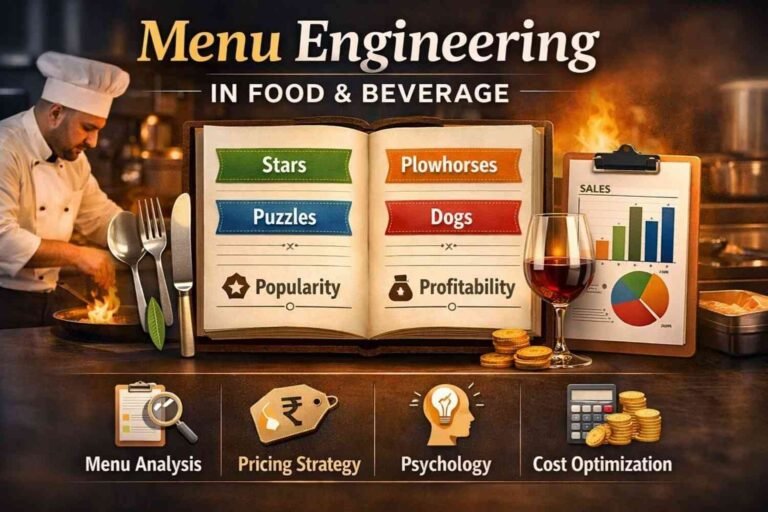
Menu engineering is a data-driven method used to analyze the popularity and profitability of dishes on a restaurant menu.
Hospitality researchers Michael Kasavana and Donald Smith first introduced this concept in 1982 while studying restaurant profitability.
The goal is straightforward:
Increase restaurant profits while maintaining customer satisfaction.
Menu engineering analyzes two key factors:
- Popularity – How often customers order a dish
- Profitability – How much profit the dish generates
By studying these two factors, restaurant managers can identify which items to promote, adjust, or remove from the menu.
In simple terms, menu engineering combines:
- psychology
- pricing strategy
- sales data
- restaurant menu analysis
This approach helps restaurants create a menu that sells the right dishes at the right price.
Why Menu Engineering Matters for Restaurants
Restaurants operate on tight margins. Rising ingredient prices, high rent, and labor costs make profitability difficult.
Menu engineering helps solve these challenges by improving food cost optimization and guiding customer choices.
Here are the main benefits.
1. Improves Menu Profitability
Menu engineering helps identify dishes that generate the highest profit.
Restaurants can promote these dishes by adjusting menu placement, descriptions, or pricing.
This process is called menu item profitability analysis.
2. Supports Smart Pricing
Restaurants cannot guess menu prices. They must consider ingredient costs, preparation time, and customer expectations.
Menu engineering allows operators to calculate contribution margins and make better pricing decisions.
3. Enhances Restaurant Menu Design Strategy
Menu layout affects what customers order. Strategic menu design places profitable dishes in visible positions.
Many studies show that customers often choose items they notice first on a menu.
Therefore, a strong restaurant menu design strategy can influence sales.
4. Helps with Food Cost Optimization
Restaurants track ingredient costs for every dish.
If a dish becomes expensive to produce, managers can:
- adjust portion size
- change ingredients
- Update the selling price
- Replace the dish
This process improves food cost optimization without harming quality.
The Four Categories of Menu Engineering
One of the most important concepts in menu engineering in restaurants is the classification of menu items.
According to hospitality research, menu items fall into four categories based on popularity and profit margin.
1. Stars
Stars are the ideal menu items.
They are:
- highly profitable
- frequently ordered
Restaurants should highlight these items on the menu and promote them heavily.
Example strategies include:
- adding photos
- placing them in menu “sweet spots”
- recommending them through servers
2. Plowhorses
Plowhorses are popular but less profitable.
Customers love these dishes, but the restaurant earns less profit.
Restaurants often improve these items by:
- adjusting portion size
- slightly increasing price
- reducing ingredient costs
3. Puzzles
Puzzles generate high profit but sell less often.
These dishes may need better marketing.
Restaurants might:
- rewrite menu descriptions
- reposition them on the menu
- train servers to recommend them
4. Dogs
Dogs are both unpopular and low-profit items.
Restaurants often remove these dishes from the menu or completely redesign them.
How Restaurants Conduct Menu Profitability Analysis
Restaurants follow a structured process when performing menu profitability analysis.
Here are the key steps.
Step 1: Calculate Food Cost
Managers calculate the total cost of ingredients for each dish.
This includes:
- raw ingredients
- cooking oil and spices
- preparation costs
Step 2: Determine Contribution Margin
Contribution margin equals:
Selling price – food cost
This number shows how much profit each dish generates.
Step 3: Analyze Sales Data
Restaurants examine POS data to see how often customers order each dish.
This creates the restaurant menu analysis.
Step 4: Categorize Menu Items
Managers classify dishes into the four menu engineering categories:
- Stars
- Plowhorses
- Puzzles
- Dogs
This framework helps restaurants decide what to promote, modify, or remove.
Menu Engineering and Restaurant Psychology
Menu engineering also uses psychology.
Research shows that menu design influences customer choices.
Some common techniques include:
Strategic Menu Placement
Customers usually notice the middle and top-right areas of a menu first.
Restaurants place profitable dishes in these areas.
Descriptive Menu Language
Detailed descriptions increase perceived value.
For example:
- “Traditional Butter Chicken”
- “Slow-cooked Punjabi Butter Chicken”
Studies show descriptive menu labels can increase sales and customer satisfaction.
Removing Currency Symbols
Some restaurants remove currency symbols from menus.
This small change can reduce price sensitivity.
Menu Engineering in the Indian Restaurant Industry
India’s restaurant industry continues to grow rapidly.
Major food and beverage companies in India include:
- quick-service restaurant chains
- cloud kitchens
- luxury hotel restaurants
- regional restaurant brands
These businesses rely heavily on menu engineering because:
- Food costs fluctuate frequently
- customer preferences vary by region
- competition remains intense
For restaurants in metropolitan cities, consulting experts such as a Food and Beverage Consultant can help implement advanced menu analysis and pricing strategies.
Hospitality consultants often evaluate:
- menu structure
- Food Cost Control
- kitchen workflow
- equipment efficiency
Restaurants may also work with a Commercial Kitchen Equipment Manufacturer in Delhi to design efficient kitchens that support menu operations.
The Role of Equipment in Menu Engineering
Menu engineering does not work in isolation.
Kitchen infrastructure also influences menu profitability.
Restaurants need equipment that supports menu items efficiently.
For example:
- high-volume fryers for fast-moving dishes
- specialized ovens for signature items
- refrigeration for ingredient storage
Many restaurants collaborate with a Commercial Kitchen Equipment Manufacturer in Rohini when designing their kitchens.
These manufacturers help restaurants select equipment that matches their menu strategy.
For instance, restaurants working with Restrobar Kitchens can view their location on Google My Business to explore commercial kitchen setups designed for modern restaurants.
The right equipment allows restaurants to execute menu strategies without increasing operational costs.
Menu Engineering and Hospitality Professionals
Menu engineering plays a major role in food and beverage service in hotel management.
In hotels, F&B managers use this strategy to manage:
- restaurants
- banquet menus
- room service menus
- bar menus
Hospitality professionals regularly perform restaurant menu analysis to keep menus updated.
Many hotels review menu performance every few months.
Consultants, including a Food and Beverage Consultant in Delhi, often assist hotels and restaurants in optimizing menus for profitability and customer experience.
Common Mistakes Restaurants Make in Menu Engineering
Even experienced restaurant owners make mistakes.
Here are common problems.
Ignoring Data
Some restaurants rely on intuition instead of sales data.
Menu engineering requires accurate numbers.
Overcrowded Menus
Large menus confuse customers and increase kitchen complexity.
Simplified menus often perform better.
Poor Pricing Strategy
Pricing must consider both costs and customer perception.
Setting prices too low can damage profitability.
Ignoring Menu Design
A poorly designed menu reduces sales of profitable dishes.
Restaurants must treat menu design as a marketing tool.
Ready to Improve Your Restaurant’s Menu Performance?
Menu engineering works best when experts analyze your restaurant data, kitchen workflow, and customer behaviour together. If you want to improve profitability, optimize food costs, and design a menu that truly sells, working with an experienced Food and Beverage Consultant can make a significant difference.
Professional consultants can help you conduct detailed restaurant menu analysis, identify high-profit dishes, and build a smart restaurant menu design strategy that increases revenue while enhancing the guest experience.
If you are planning to upgrade your restaurant operations or kitchen setup, you can also explore solutions from a Commercial Kitchen Equipment Manufacturer to ensure your kitchen supports your menu strategy efficiently.
For restaurants looking for professional kitchen solutions and consultation, you can also find Restrobar Kitchens on Google My Business to explore their services and location.
Start optimizing your menu today and turn your restaurant into a more profitable and efficient business.


